
Considering RF microneedling or laser treatment
Eight questions to ask at your consultation
Choosing between RF microneedling and laser rejuvenation starts with an assessment of your skin, rather than a treatment name. Your goals, medical history and ability to follow aftercare all matter. Neither option is the right choice for everyone.
If you are exploring skin rejuvenation in Palm Beach Gardens, bring these eight questions to your consultation. They can help you understand the recommendation, weigh the risks and decide whether the proposed plan fits your life.
What research can tell us
Much of the direct comparison research focuses on acne scars, not every form of skin aging. A 2026 analysis pooled eight randomized trials involving 249 patients. Fractional CO2 laser produced greater improvement in scar ratings and satisfaction on average, but also more pain, more dark marks after treatment and longer-lasting redness than RF microneedling. [1]
Another 2026 review found encouraging RF microneedling results for texture and some signs of aging. However, studies used different devices and settings, and long-term evidence was limited. [2] These findings support a personalized discussion rather than a universal winner.
1 What do these treatment names mean?
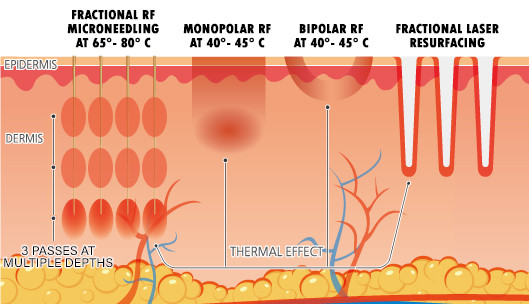
RF microneedling uses small needle electrodes to deliver radiofrequency energy into tissue, creating heat. It differs from conventional microneedling, which does not add RF energy. Ask which exact device is being proposed and how it would be used for your concern. [3]
Laser rejuvenation describes several approaches. Ablative lasers remove outer skin layers; nonablative lasers treat without removing those layers. Fractional lasers treat small columns of tissue and can be either type. Intense pulsed light, or IPL, is a different light treatment, not a laser. These distinctions affect the treatment experience and recovery. [4]
2 What improvement is realistic for my concern?
Be specific about what you hope to change. Acne scars, fine lines, uneven texture and discoloration are different concerns. Ask your clinician to identify the concern being treated and explain why the proposed approach fits it.
A 2025 review of 16 studies involving 481 patients found RF microneedling promising for acne scars, while calling for better trials to establish treatment parameters. [5] Ask what evidence supports the exact treatment proposed for you, what improvement is realistic and what is unlikely to change. Before-and-after photographs can help frame the conversation, but they cannot predict your result.
3 How do my skin and health history affect the choice?
Your skin tone and tendency to develop dark marks deserve attention. Laser resurfacing can cause lighter or darker patches; people with brown or Black skin face a higher risk of lasting color changes. [6] Research on RF and RF microneedling in darker skin tones is encouraging, but much of it is low quality, and pigment changes and scarring have been reported. [7] Ask how your skin affects the recommendation.
Share your medical conditions, medications and supplements, recent skin treatments, cold sore history and any problems with healing or raised scars. Mention recent tanning or sunburn, too. Bring a list rather than relying on memory. Ask whether anything needs to be treated or allowed to settle first. Do not stop a prescribed medication on your own; any changes should be coordinated with the relevant clinician.
4 Who will perform the procedure?
Ask who will assess your skin, perform the treatment and manage follow-up. Request details about their license, training on the proposed device and experience treating people with similar skin tones and concerns. A device name alone does not tell you who will be operating it.
For RF microneedling, ask about the device’s FDA clearance and the indication it covers. Clearance is device- and use-specific, not a promise of a particular result. [3] Ask how the planned treatment relates to that indication.
5 What risks should we discuss before I decide?
The FDA’s October 2025 safety communication reports serious complications with certain uses of RF microneedling, including burns, scarring, fat loss, disfigurement and nerve damage. Some injuries required surgery or other medical care. The FDA’s evaluation is ongoing. RF microneedling is a medical procedure. [3] Favorable study results do not remove the need to discuss these risks.
Laser resurfacing also carries risks, including infection, cold sore flare-ups, pigment changes and scarring. [6] Ask which risks apply to your treatment, how they would be reduced and how a complication would be managed. Discuss alternatives, including postponing treatment or choosing no procedure.
6 What recovery should I plan for?
Ask for a recovery plan for your exact procedure, treatment area and settings. “Minimal downtime” does not explain when you can return to work or feel ready for a social event. Laser recovery varies, and some procedures require wound care. [8]
Clarify when you can return to work, wear makeup, exercise, swim and restart your usual skin care. Ask how to protect healing skin from the sun and when to begin recommended products. In Palm Beach Gardens, consider outdoor plans and travel before choosing a date. Leave room for recovery rather than scheduling around a promised finish date.
Ask about discomfort and numbing, too. In a small acne-scar trial, RF microneedling was more painful than fractional CO2 laser, despite less early redness. [9] Comfort cannot be assumed from a treatment category.
7 How many treatments might I need and what is the total cost?
Ask when improvement may become visible, when the result should be assessed and whether additional sessions or maintenance may be needed. Collagen-related changes can develop gradually; general microneedling guidance describes improvement over weeks to months. [10] Your clinician should set expectations for the specific treatment rather than transfer a timeline from another procedure.
Request a written estimate for the proposed course, including follow-up visits and recommended aftercare products. Clarify what is included, what could cost extra and when the plan would be reassessed if your skin does not respond as hoped. Avoid judging the options by a single-session price alone.
8 What should I know before leaving the consultation?
You should be able to explain the proposed treatment, why it was recommended and the main risks in your own words. Ask for written preparation and aftercare instructions, signs that need prompt medical attention and a clear contact route if you are worried after treatment.
A medical consultation is important before laser treatment. [11] Give yourself the same space to ask questions about any procedure. If an important answer remains unclear, pause and ask for clarification before booking.
Considering skin rejuvenation in Palm Beach Gardens? Visit Luxe Arte Aesthetics to learn more, and bring this guide to a consultation to discuss your goals and whether either treatment is appropriate for you.
This article provides general education and does not replace an individual medical assessment.
References
1. Argobi Y, Tobeigei F, Alasiri FI. Fractional CO2 Laser Versus Micro Needling Radiofrequency for Post Acne Scarring: A Meta-Analysis of RCTs. J Cosmet Dermatol. 2026;25(3):e70765. Read source DOI 10.1111/jocd.70765
2. Kumar N, Kim HM, Nishikawa A, Heo CY, Wu WTL. Effectiveness of Radiofrequency Microneedling in the Treatment of Dermatological Conditions: A Systematic Review. Aesthetic Plast Surg. 2026;50:5282–5317. Read source DOI 10.1007/s00266-026-05834-y
3. U.S. Food and Drug Administration. Potential Risks with Certain Uses of Radiofrequency (RF) Microneedling. Safety communication. October 15, 2025. Read source
4. Johns Hopkins Medicine. Laser Skin Resurfacing and Other Rejuvenation Treatments. Patient education. Read source
5. Niaz G, Ajeebi Y, Alshamrani HM, Khalmurad M, Lee K. Fractional Radiofrequency Microneedling as a Monotherapy in Acne Scar Management: A Systematic Review of Current Evidence. Clin Cosmet Investig Dermatol. 2025;18:19–29. Read source DOI 10.2147/CCID.S502295
6. Mayo Clinic. Laser resurfacing. Patient education. Read source
7. Syder NC, Chen A, Elbuluk N. Radiofrequency and Radiofrequency Microneedling in Skin of Color: A Review of Usage, Safety, and Efficacy. Dermatol Surg. 2023;49(5):489–493. Read source DOI 10.1097/DSS.0000000000003733
8. American Society of Plastic Surgeons. Special considerations, risks and recovery. Laser skin resurfacing. Read source
9. Hendel K, Karmisholt K, Hedelund L, Haedersdal M. Fractional CO2-laser versus microneedle radiofrequency for acne scars: A randomized, single treatment, split-face trial. Lasers Surg Med. 2023;55(4):335–343. Read source DOI 10.1002/lsm.23655
10. American Academy of Dermatology. Microneedling can fade scars, uneven skin tone, and more. Updated July 17, 2023. Read source
11. American Academy of Dermatology. 10 things to know before having laser treatment for your scar. Read source
Related reading
CO2 laser recovery and conventional versus RF microneedling.
Ready to Learn More?
Schedule a consultation to discuss your aesthetic goals and discover which treatments are right for you.
Book ConsultationMore Articles